politics
декабрь 25, 2025
La Navidad diseñada por Rosario Murillo para ocultar una Nicaragua rota por la separación familiar
En Nicaragua, las fiestas de fin de año se celebran entre el desborde lumínico que inunda plazas con estructuras monumentales como parte de la puesta en escena de la Navidad oficialista impuesta por Rosario Murillo, y el apagón emocional de miles de familias fracturadas por la migración forzada, el exilio y la represión. Esta es la otra postal navideña: la de un país fragmentado, con familias que no pueden volver a estar juntas y abrazarse en Nochebuena
TL;DR
- Nicaragua's official Christmas decorations feature monumental structures, intense lights, and esoteric symbols like "Trees of Life" in public spaces.
- This official display contrasts with the reality of thousands of families separated by political repression, forced migration, exile, and imprisonment.
- As of December 2025, 62 people are detained for political reasons, with at least 28 forcibly disappeared, according to the Mechanism for the Recognition of Political Prisoners.
- The regime arbitrarily denies entry to some citizens and has stripped others of their nationality.
- Journalistic reports and expert analysis suggest the "Trees of Life," introduced around 2013, contain esoteric symbols like the "all-seeing eye" and "Eye of Horus," deviating from traditional Christian iconography.
- Semiotics specialist Addis Esparta Díaz interprets these symbols as an attempt by Murillo to create a personal iconography linked to mysticism and power, using colors like fuchsia, gold, and purple to project emotional control and institutionalized spirituality.
- The extensive public spending on these decorations is criticized as disconnected from urgent social priorities like forced migration, unemployment, and deteriorating basic services.
- The regime's instrumentalization of religious and festive symbols is seen as an appropriation of popular faith for its legitimization narrative, promoting an image of normality that hides societal tensions.
- Since 2018, mass protests and subsequent state repression have led to significant forced migration, with hundreds of thousands of Nicaraguans leaving the country.
- Exiled individuals are often denied essential documents, leaving them in a state of undocumented status and migratory vulnerability.
- The prolonged family separation due to exile and migration has profound social and emotional effects, leading to fragmented family networks and a disconnection from cultural traditions.
- For those remaining in Nicaragua, Christmas is marked by video calls, remittances, and the absence of loved ones, while those in exile experience a similar profound sense of loss and broken ties.
From Managua to rural communities, the official Christmas projected by co-president Rosario Murillo floods squares, avenues, and roundabouts with monumental structures, intense lights, and esoteric symbols. At the same time, thousands of Nicaraguan homes live a reality fragmented by the repression established by the Sandinista regime.
These are thousands of families separated by forced migration, the exile of persecuted relatives, and the absence of those who remain imprisoned or disappeared for political reasons. As of December 2025, the Mechanism for the Recognition of Political Prisoners in Nicaragua documents 62 people detained for political reasons, of whom at least 28 are forcibly disappeared, leaving their families without information about their whereabouts or legal status.
Added to this fracture are the households of people whom the regime arbitrarily denies entry to their own country or has stripped of their nationality. However, allied media and official communiqués show a display of Christmas decorations as signs of tradition, joy, and family unity.
A narrative that seeks to consolidate the perception of normality, even when statistics on forced migration, testimonies of exiles, and data on arbitrary detentions reveal a context of persistent social fracture since 2018.
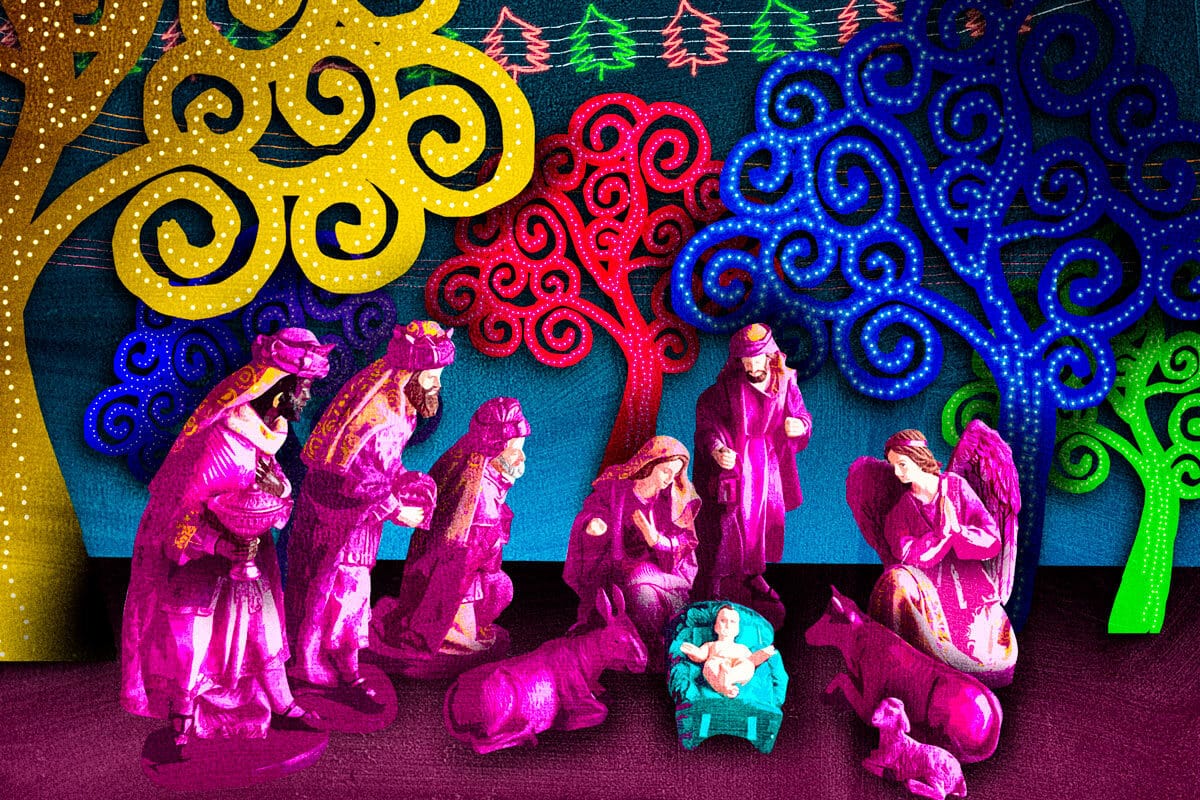
Since that year, when the country was bled dry by the massacre perpetrated by the Sandinista dictatorship against civil protests, Christmas decorations in Nicaragua ceased to be a traditional festive adornment. Each season, public space is transformed with the installation of giant trees, lights, and metal structures called "Trees of Life" by the dictatorship's narrative. These pieces are erected in roundabouts, squares, and main avenues, with vibrant color palettes and a design that evokes traditional Christian iconography.
According to journalistic publications, the Ortega-Murillo regime introduced these symbols starting in 2013, gradually replacing classic Christmas trees with structures with volutes and shapes that specialists have described as linked to esoteric and cabalistic references.
Semiotic Analysis: Esoteric Symbols and Codes of Power
The codes of the Sandinista propaganda message present in traditional Christmas symbols, such as nativity scenes. DIVERGENTES / Taken from El 19 Digital.
In an interview with La Prensa, semiotics specialist Addis Esparta Díaz analyzed the "Trees of Life" promoted by Rosario Murillo since 2013. According to her analysis, which is still valid today, these elements contain hidden symbols with strong esoteric connotations, which deviate from the traditional religious representations of the Nicaraguan people.
"There are hidden esoteric icons such as the eye of balance or the eye of power. The circles that repeat within the trees represent the all-seeing eye, or the Eye of Horus, a symbol of eternity of being," Díaz explained in that interview.
The expert interpreted these structures as an attempt by Murillo to replace the classic symbols of Sandinismo with a personal and syncretic iconography, with references to mysticism and her own visions of power. In Díaz's opinion, this set of symbols introduces a new symbolic narrative from the state apparatus.
She also warned about the meaning behind the predominant colors in these structures. "Fuchsia represents the emotional plane, mysticism. Gold, the spiritual plane. And purple, the celestial plane. There is no balance," she explained.
From her perspective, the insistence on these tones responds to a closed code that attempts to project emotional control, institutionalized spirituality, and an imposing aesthetic in public space. This approach, she said, generates a "divorce between Catholic religious symbology and the esoteric symbology promoted by power."
Díaz's analysis remains valid and helps explain why the regime's Christmas decorations deviate from the religious and cultural traditions shared by generations in Nicaragua. Instead of reinforcing collective symbols, an alien visual system is imposed, marked by cryptic symbols and dominant colors, which acts as a visual signature of power and contributes to the narrative of the regime's omnipresent presence in daily life.
Trees of Life: Gigantism and Public Spending
The Trees of Life as part of the Christmas decoration promoted by the Sandinista regime. DIVERGENTES / Taken from El 19 Digital.
The "Trees of Life" became the center of official celebrations. These metal structures, which can measure up to 20 meters high and weigh several tons, are illuminated with thousands of LED bulbs and require inter-institutional coordination for their installation. The repetition of these icons in multiple municipalities has consolidated a homogeneous aesthetic throughout the country.
This year, the regime, through propaganda media, announced the installation of more than 130 new lighting installations throughout the national territory and more than 400 activities every weekend since November.
"The Christmas ornamentation promoted by the regime functions as a mechanism of political visibility. It is an aesthetic use of public space that seeks to reinforce the idea of state presence, even if it is disconnected from the most urgent social priorities," points out an expert in public investment who preferred to be cited anonymously to avoid reprisals against her or her family.
She also commented that "in a context of forced migration, unemployment, and deterioration in basic services, allocating millions to decorative structures reflects a hierarchy of interests that does not respond to the real needs of the population."
Instrumentalization of the Religious and Festive
The official Christmas decoration combines religious symbols, scenes of the birth of Jesus, and monumental trees, merging Christian iconography with elements apparently unrelated to established religious traditions. Media aligned with the regime describe these spaces as places for family gatherings, domestic tourism, and community celebrations.
However, independent observers warn that this mixture responds to an institutional appropriation of popular faith as part of the regime's legitimization narrative. The promotion of these spaces as displays of "Christmas magic" in urban areas contributes to a message of normality and stability that hides structural tensions in Nicaraguan society.
"The official narrative accompanying these decorations emphasizes 'peace,' 'love,' and 'family unity,' recurring terms in Rosario Murillo's communiqués and speeches. It is her official signature," points out the same anonymous source.
The experience of the official Christmas contrasts sharply with the reality of thousands of Nicaraguans who live separated from their families due to repression and forced migration. Since the outbreak of protests in 2018 and the intensification of state repression, a significant portion of the population has chosen to leave the country in search of security and opportunities, or has been expelled by the regime.
Carlos, a 59-year-old Nicaraguan residing in Chinandega, will not spend Christmas with his only daughter and his two grandchildren. Since 2021, they have been living in Costa Rica, where they fled after suffering direct threats and police harassment. "They are not coming this year either. They cannot return. They are safe there, even though I wish I could have them here. It's three Christmases without them, and we don't know how many more we will spend like this," he says with a choked voice.
His testimony summarizes what many Nicaraguan families are experiencing. Political persecution and the prohibition of return have imposed irreparable distances that are felt more strongly at this time of year.
Christmas Broken by Exile and Migration
Illumination that overflows to disguise the sadness and anguish of family separation. DIVERGENTES / Taken from El 19 Digital.
For many people in exile, Christmas arrives accompanied by a prolonged state of unprotectedness. Those identified by the regime as opponents are not only prevented from returning to Nicaragua but are also denied essential documents such as passports, ID cards, and birth certificates, preventing them from rebuilding their legal and family lives from abroad.
Juan Carlos Arce, a lawyer and human rights defender from the Colectivo Nicaragua Nunca Más, warns that these regime actions "leave victims in a state of undocumented status, migratory vulnerability, and risk (…), depriving them of basic civil rights and legal recognition as nationals."
He also points out that this is a form of persecution that extends beyond the country's borders. "The State exercises transnational control that leaves hundreds of Nicaraguans without the means to prove their identity, protect their migratory status, or defend their civil and family rights," he adds.
These measures affect entire families, including minors, and in December their impact is most visible because it creates divided households, stalled procedures, and broken ties that function as a form of political punishment.
Data compiled by independent media and regional organizations indicate that Nicaraguan migration accelerated since 2018, with hundreds of thousands of people leaving the country. In 2023, around 115,000 Nicaraguans emigrated due to the sociopolitical crisis, with main destinations such as the United States and Costa Rica, and it is estimated that more than 1.5 million live outside the country, equivalent to approximately 22% of the total population, according to analyses by migration specialists.
Social Effects of Migration and Exile
According to a Nicaraguan psychologist who prefers to remain anonymous, prolonged family separation has profound social and emotional effects. "Families that historically celebrated together are now scattered across different countries, facing economic, legal, and emotional barriers to reuniting. Forced migration, moreover, has generated an active Nicaraguan diaspora that maintains ties with their country of origin through community networks, civil organizations, and, in many cases, economic support to those left behind," she comments.
For many Nicaraguans like Carlos, who is in Nicaragua, Christmas means video calls, sending remittances, and a palpable absence at family tables. It is the same for those outside. The expert points out that this phenomenon has further fragmented family and community networks, intensifying the sense of disconnection with the cultural traditions that Christmas officially celebrates, as DIVERGENTES reveals in the recent report From Costa Rica to Spain: Nostalgic Christmas for Nicaraguans.
"Since I've been in exile, I haven't had a traditional Christmas dinner. I don't even feel like dressing up for the evening because there's no one to visit, nor anyone to expect because my entire family is in my country," says Lucía, a Nicaraguan exiled in Costa Rica.
The information we publish on DIVERGENTES comes from verified sources. Due to the situation in the region, we are often forced to protect them under pseudonym or anonymity. Unfortunately, some governments in the region, with the Nicaraguan regime at the head, do not provide information or censor independent media. Therefore, despite requesting it, we cannot rely on authorized official versions. We resort to data analysis, anonymous internal sources, or the limited information from officialist media. These are the conditions under which we practice a profession that, in many cases, costs us our safety and our lives. We will continue to report.