politics
декабрь 25, 2025
Nicaragua, the “Hub” of Russian Propaganda in Central America
The country has become a testing ground for Russian state media outlets RT and Sputnik, broadcasting pro-Russian and anti-Western narratives
TL;DR
- *Juventud Presidente* (JP+) shifted from a local pro-Sandinista outlet to an international platform promoting Russian narratives after February 2022.
- Nicaragua is identified as a crucial base for Russian propaganda, aiming to influence Latin America with disinformation disguised as news.
- The strategy involves amplifying false narratives about the Ukraine invasion and portraying Russia and China as leaders of a new world order, while attacking the U.S. and EU.
- Daniel Edmundo Ortega Murillo, son of the Nicaraguan president, plays a key role in coordinating media efforts and signing agreements with Russian outlets like RT and Sputnik.
- JP+ acts as a testing ground for Russian propaganda strategies in Central America, utilizing social media, bots, and troll farms.
- These disinformation campaigns aim to shift public opinion, discourage aid to Ukraine, and weaken the U.S.'s influence in its 'backyard'.
- Media cooperation agreements facilitate training and exchanges between Russian and Nicaraguan journalists, strengthening the propaganda network.
Until 2022, Juventud Presidente was a communications initiative run by the Sandinista Communicators Network, focused on local news supportive of Daniel Ortega’s regime. Its Facebook page, launched in February 2011, was limited to sharing postcards with messages in favor of the Sandinista National Liberation Front (FSLN) and photographs of various activities originally published by the official press.
With Russia’s invasion of Ukraine in February 2022, the platform began transforming into an international outlet under the brand JP+. Today, it has over 834,000 YouTube subscribers and 970,000 Facebook followers, a rapid growth reflecting an editorial shift that is neither accidental nor casual. It is deliberate and strategic.
JP+ started publishing videos promoting false narratives about the Russian invasion. While the European Union (EU) suspended the broadcasts of Sputnik and RT, accusing them of being Kremlin disinformation tools, Russia redirected its propaganda machinery toward Latin America.
The region, particularly countries with historical tensions with the United States, such as Nicaragua, Venezuela, and Cuba, became fertile ground for these messages. “Nicaragua is a base of operations for Russian propaganda,” says Robert Evan Ellis, professor at the U.S. Army War College. According to Ellis, RT and Sputnik are part of a disinformation ecosystem designed to strengthen the Managua-Moscow alliance and challenge the regional narrative promoted by the U.S. and the EU.
When the EU blocked Russian media, Daniel Edmundo Ortega Murillo, Media coordinator at the Council of Communication and Citizenship, and son of Daniel Ortega and Rosario Murillo, defended Sputnik and RT, accusing Europe and the U.S. of attacking press freedom. He later signed several memoranda of understanding between RT, Sputnik, and pro-government media, which included, among other things, “experience exchanges.” The latest official reports indicate that the Russian channel is preparing to enter Nicaraguan broadcast television, accompanied by the arrival of RT and Sputnik journalists in the country. For now, their signal is broadcast via cable television providers in Nicaragua. These operations are part of Russia’s broader strategy to influence the region through media and disinformation.
Nicaragua and the War of Soft Power
RT’s editor-in-chief, Margarita Simonyan, has openly admitted that the network is waging an information war against the West, comparing it to the Russian Ministry of Defense. Several analysts consulted by DIVERGENTES describe this strategy as soft power, an attempt to shape state behavior through media pressure rather than economic or military force.
“It is a form of media influence. It’s not economic pressure, it’s not military pressure; it’s pressure through the media, which seems harmless but can be very damaging because it reaches the minds and sensitivities of certain regions,*”*explains Carlos Galán Cordero, director of the Intelligence Analysis Master’s program at Universidad Nebrija, Spain. For Galán, Nicaragua has become a key link for Russia to expand disinformation in Central America.
In 2022, Ellis testified before the U.S. House Foreign Affairs Subcommittee that there is credible evidence Russia is conducting “information warfare” in the region, possibly coordinated with Cuba and Venezuela.
These operations rely on social media platforms such as Twitter, Instagram, Facebook, and WhatsApp, amplified by technologies including bots and troll farms. Ellis emphasizes that these tools have been used to destabilize countries. In Nicaragua, they were deployed by the regime to reshape the narrative around the 2018 social protests.
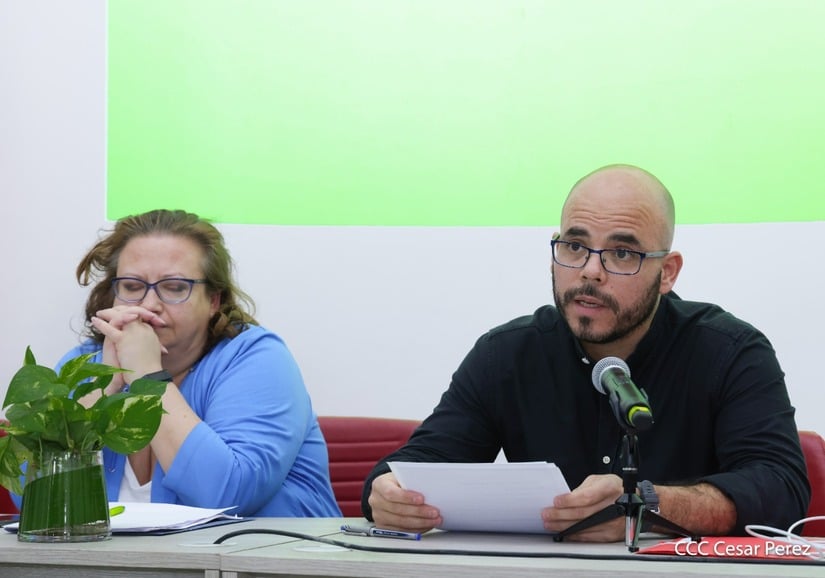
Daniel Edmundo Ortega Murillo is appointed by the dictatorship of his parents, Daniel Ortega and Rosario Murillo, to manage their propaganda and disinformation system. Divergentes | Photo taken from El 19 Digital.
A clear example occurred in 2021, when Facebook removed a network of fake accounts linked to the FSLN and various government entities, operating since 2018 to influence public opinion in favor of the government and against the opposition. That year, 937 Facebook accounts, 140 pages, 24 groups, and 363 Instagram accounts were removed, operated by institutions such as the Nicaraguan Institute of Telecommunications and Postal Services (Telcor), the Supreme Court, and the Nicaraguan Social Security Institute.
Vladimir Rouvinski, an expert on Russian influence in Latin America, agrees with Ellis that Nicaragua has become the “hub” of Russian propaganda in Central America, serving as RT’s regional center in the isthmus. “The Ortega regime essentially makes it easy for Russia to operate; it’s like a testing ground. From Nicaragua, the Russians can expand, experiment with different strategies, and that’s where the danger of propaganda lies,” he says.
Rouvinski also told Reporters Without Borders (RSF) that RT employs what political science calls “symbolic politics.” “The channel uses the same formats as Russian public television, presenting news in a way that emphasizes elements designed to provoke emotional reactions.”
In this game, Russia consolidates its influence in the region, while Ortega secures the support of a foreign power to maintain his hold on power, creating a link that blends politics, propaganda, and social control, according to experts.
Last August, Daniel Edmundo visited RT en Español and Sputnik headquarters in Moscow, part of a recurring journey since 2022. There, the son of the ruling couple claimed that “dignified peoples” constantly face what he called “media terrorism, fake news, and manipulations by fascist media companies” serving Western governments.
Breaking U.S. Hegemony
“The Tucker Carlson interview with Putin that the West wants to block,” reads the title of a JP+ YouTube video published in February 2024, which had 1.9 million views at the time of this report. This is one example of how JP+ has become a platform for amplifying messages and narratives aligned with Moscow.
Other content from the channel focuses primarily on attacking the U.S. and EU, while portraying China and Russia as leaders of a new world order. “Putin-Trump Summit Marginalizes Europe,” reads another video, whose thumbnail shows the solemn faces of Ursula von der Leyen, President of the European Commission; Volodymyr Zelensky, President of Ukraine; and Keir Starmer, U.K. Prime Minister. Views run into the thousands.
JP+ has not only grown in reach but also serves as a Managua-based vehicle for reproducing narratives aligned with Moscow’s interests, in the same vein as RT and Sputnik. According to a 2023 U.S. Institute of Peace report, Russia’s disinformation campaigns in Latin America, active since Putin’s return to the presidency, intensified following Russia’s invasions of Ukraine in 2014 and 2022.
“Their effect can be seen in shifts in public opinion and the reluctance of Latin American countries to provide aid to Ukraine or participate in sanctions against Russia,” the report notes.
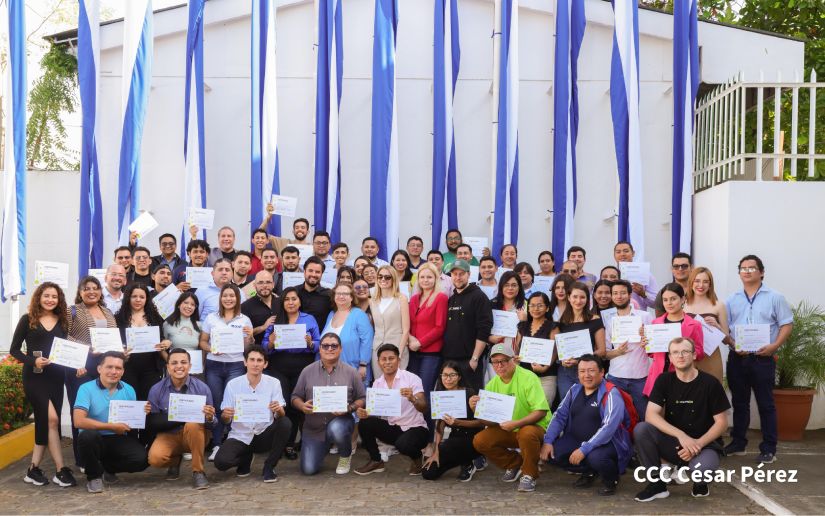
A group of Sandinista regime propagandists after a training session organized by Russia’s RT in Nicaragua. Divergentes | Photo taken from El 19 Digital.
Findings suggest that Putin has leveraged distrust of the U.S., portraying it as a resource-extractive power pushing unsuitable economic policies on Latin America, presenting Russia as a friendly, less intrusive alternative. “Successful information operations amplify Russian messages through allied media platforms and networks of influential actors, including journalists, social media influencers, diplomats, and intellectuals from both the right and left,” the report adds.
Rouvinski notes that Russia’s goal in Latin America via RT and Sputnik is essentially to project an image of the U.S. as pursuing policies contrary to Latin American interests. The expert argues that for Russia, Latin America remains the U.S.’s “backyard,” and any difficulty Washington faces in the region “can play into Moscow’s hands.” The U.S. itself acknowledged at the end of 2024 that disinformation “is one of the Kremlin’s most important and far-reaching weapons.”
But how do RT, Sputnik, and JP+ fit together? The key lies in training and exchanges between Russian and Nicaraguan journalists under media cooperation agreements. From Managua, JP+ not only replicates RT’s messages but also acts as a testing platform for Russian propaganda in Central America.
“Sputnik News and RT have conducted courses at universities, something we haven’t seen in Venezuela. Nicaragua clearly has significant influence,” warns Carlos Galán Cordero. This influence, experts stress, should raise alarms for democratic governments in the region.
- The information we publish in DIVERGENTES comes from contrasted sources. Due to the situation in the region, many times, we are forced to protect them under pseudonymity or anonymity. Unfortunately, some governments in the region, including the Nicaraguan regime, do not provide information or censor independent media. For this reason, despite requesting it, we cannot rely on official, authorized versions. We resort to data analysis, anonymous internal sources, or limited information from the official media. These are the conditions under which we exercise a profession that, in many cases, costs us our safety and our lives. We will continue to report.